
These days anybody can construct a site. With content administration frameworks, web designers, and the expansions that plug into them, you don’t have to have any coding or website architecture experience to make a custom site.
There are several stages to look over, going from big business content administration frameworks to one page web designers. Of these hundreds, WordPress is among the most mainstream and broadly utilized.
While there are numerous WordPress options, the open-source content administration framework keeps on drawing in a huge number of clients. One factor driving its prominence is WordPress modules. Modules add or upgrade the usefulness of the WordPress programming so you can assemble your site to look and do precisely what you need.
In this post, we’ll look at these apparatuses as far as plan components, layouts, inherent usefulness, speed, and valuing. That way, you’ll have the option to settle on an educated choice about which to use to fabricate your WordPress site.
Divi versus Elementor
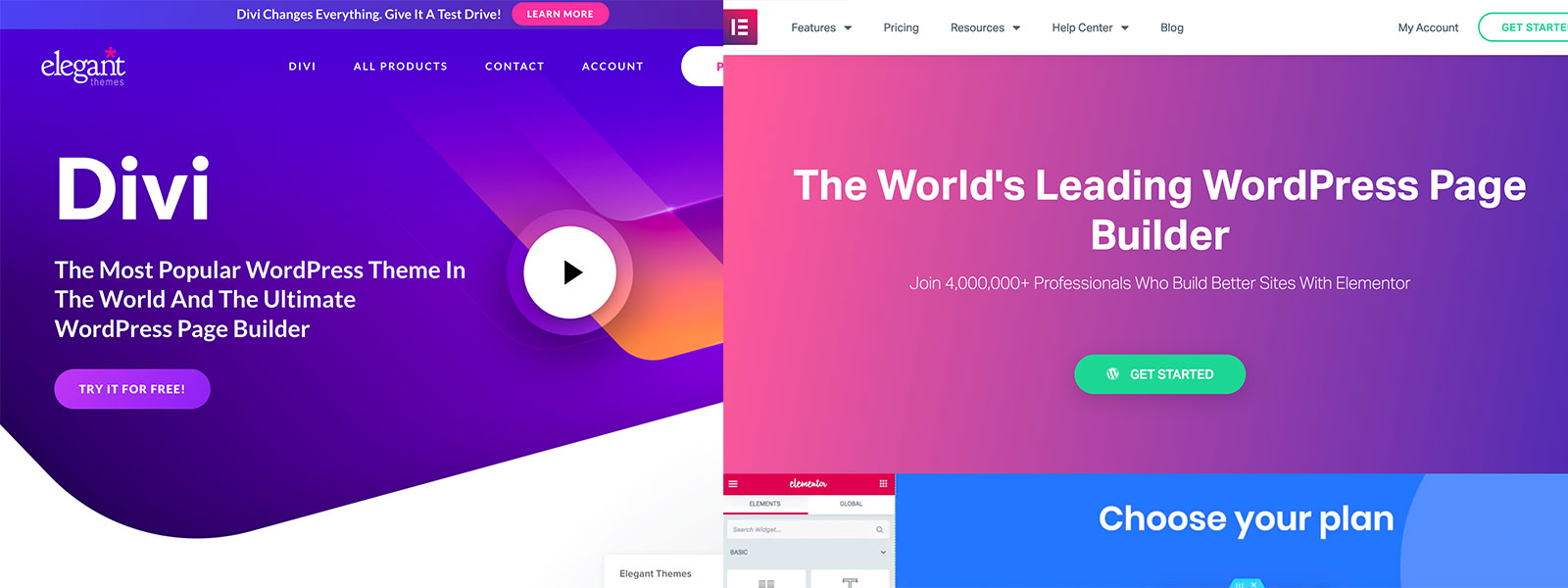
Divi is a well known site developing stage made of a subject and visual simplified page developer that replaces the standard WordPress post editorial manager. It’s known for its enormous layout determination and progressed highlights, incorporating an inherent split testing framework. Elementor is likewise a visual intuitive developer utilized by a great many WordPress clients. It is an independent module that offers less layouts however more plan components than Divi.
To assist you with choosing which site building arrangement is appropriate for your WordPress site, we’ll examine key contrasts between the modules underneath.
Plan components
WordPress accompanies a default proofreader known as the Gutenberg supervisor. Despite the fact that it’s simpler to utilize and more remarkable than the past Classic proofreader, Gutenberg is as yet restricted in usefulness and adaptability when contrasted with modules like Divi and Elementor. Since both these modules give more plan components than the inherent supervisor, they’ll empower you to manufacture more unpredictable pages. However, how would they contrast and one another?
Divi
The Divi manufacturer offers more than 40 site components, including catches, call to activities, exhibitions, sliders, websites, structures, and tributes. While a portion of these components are in the Gutenberg editorial manager also, Divi gives a lot more customization alternatives.
Take the catch component for instance. For the catch block in the Gutenberg editorial manager, you can settle on the fill or diagram style, add an inline picture, change the content and foundation tone, and round the edges.
Catch toolbar and sidebar settings in Gutenberg editorial manager in WordPress dashboard
In the Divi manufacturer, you have three tabs of settings you can arrange. You can change the arrangement, text and foundation tone, situating, edge, cushioning, outskirt, and symbol. You can add a channel, movement, or looking over impact. You can alter these settings for work area, tablet, and cell phones or conceal the catch on any of these gadgets.
Divi additionally offers a WooCommerce manufacturer with 16 WooCommerce modules so you can make and modify an internet business store.
Elementor
Elementor offers more than twofold the plan components (additionally called gadgets) as Divi. It offers a determination of “fundamental” gadgets that are accessible in the free form of Elementor. In spite of the name, they are not standard and incorporate star rating, Google Maps, counter, tabs, progress bar, and caution.
Like Divi, Elementor gives various tabs of configurable settings for every component. For the star rating gadget for instance, you can set the rating scale, symbol, style, arrangement, size, and separating of the title and stars.
Gadgets accessible in Elementor Pro are significantly further developed. These incorporate portfolio, vivified feature, value rundown or table, commencement, audits, and Facebook catch and remarks. Like Divi, Elementor likewise offers WooCommerce-explicit gadgets, including item breadcrumbs, item appraising, item related components, and 16 others, so you can make a custom shop or site with Elementor Pro.
Layouts
Layouts are pre-planned pages or segments of a page, similar to a header. Formats have one of a kind designs with areas, lines, and modules that are normally intended for a particular page, similar to a landing page, evaluating page, or contact page. These layouts are exceptionally adjustable and help accelerate the assemble cycle for your site.
Divi
What truly sets Divi separated from other page developers, including Elementor, is its format determination. In addition to the fact that it has the biggest choice with more than 800 formats, however it likewise offers them as “site packs.” These site packs incorporate eight formats that are planned with a similar subject or business specialty so you can make a site with a reliable look and feel on each page.
The Hosting Company pack, for instance, incorporates a landing page, About page, blog page, point of arrival, valuing page, item page, and administrations page. Here’s a glance at the About page.
Elementor
Elementor offers more than 200 pre-planned formats. Some are “themed” together. For instance, there’s a landing page, administrations, and contact page for a “Snowboard site.” But most are definitely not.
Prior to 2019, Elementor offered just single layouts. This made it hard to make a steady search for a whole site, so they started delivering format units. Packs are comprised of a landing page, About page, a Contact Us page, Services page, Main Blog or Archive page, Blog Post or Single page, a 404 page, and header, footer, and popup formats. With endless formats, these packs will empower you to make a reliably marked site.
Usefulness
All page manufacturer modules offer a wide scope of plan components and formats, which make them an engaging option to the underlying editorial manager in WordPress. Divi and Elementor offer significantly more highlights to assist you with building and plan your site in less time. How about we take a gander at a portion of these highlights underneath.
Divi
Divi offers many highlights intended to improve proficiency and spare you time. For instance, you can duplicate a style from one component and glue it onto another. There’s no compelling reason to open up each individual component’s plan settings and alter them in precisely the same manner. You can likewise utilize Divi’s discover and supplant highlight to make changes to a particular sort of component over your site — like changing the shade of your catches from pink to blue — instead of finding and changing the settings of each catch that shows up on a page. Or on the other hand you can alter a gathering of components on the same wavelength all the while with Divi’s multi-select element.
Picture Source
Divi is additionally known for its streamlining and configuration instruments. It accompanies an underlying split testing framework so you can make and test various variants of a page to figure out which variety performs better. You may locate that specific catch arrangements, colors, or even totally various designs perform in a way that is better than others. Another one of a kind element is Divi’s Magic Color Manager. This shading framework consequently recollects and stores your as of late utilized tones for simple access and recommends new tones for your present palette.
Elementor
Elementor’s most popular element is likely its popup manufacturer. With this instrument, you can assemble any kind of popup or structure you have to change over guests into leads, from a doormat to declarations and advancements to content locks. Every one of these structures can be inherent the accompanying styles: Fly In, Full Screen, Hello Bar, Bottom Bar, Classic, and Slide-in.
You can set conditions, triggers, and progressed rules for these popups to guarantee they’re are placed before the perfect individuals at the perfect time. For instance, you may trigger them dependent on how far down the page the guest has looked over or the number of pages they’ve seen.
Also, you don’t need to manufacture these without any preparation all things considered. Elementor offers more than 100 popup layouts. Here’s a case of a login structure:
Speed
To give the best guest experience, your site must be appealing, simple to explore, and quick. 47% of customers expect a page to stack in two seconds or less and Google utilizes load times as a positioning variable for search.
To enhance your site for the two guests and web indexes, you need a page manufacturer that is lightweight and neatly coded. How about we perceive how Divi and Elementor analyze.
Divi has gained notoriety for being more slow than Elementor, however it’s been disproven by speed tests. For instance, Pagely ran a test contrasting the heap season of a presentation page site on the most famous page manufacturers, including Divi and Elementor. On the Pingdom Website Speed tests, the page worked with Divi stacked in 463 ms and the page worked with Elementor stacked in 489 ms.
Valuing
Divi and Elementor are both premium modules, however each has an exceptional valuing model. We should investigate each underneath so you can discover the arrangement that turns out best for your site and spending plan.
Picture Source
Elem


0 Comments